
Why use Biilby when I already have ChatGPT?
Published August 26, 2026 · By Frédéric Debouche
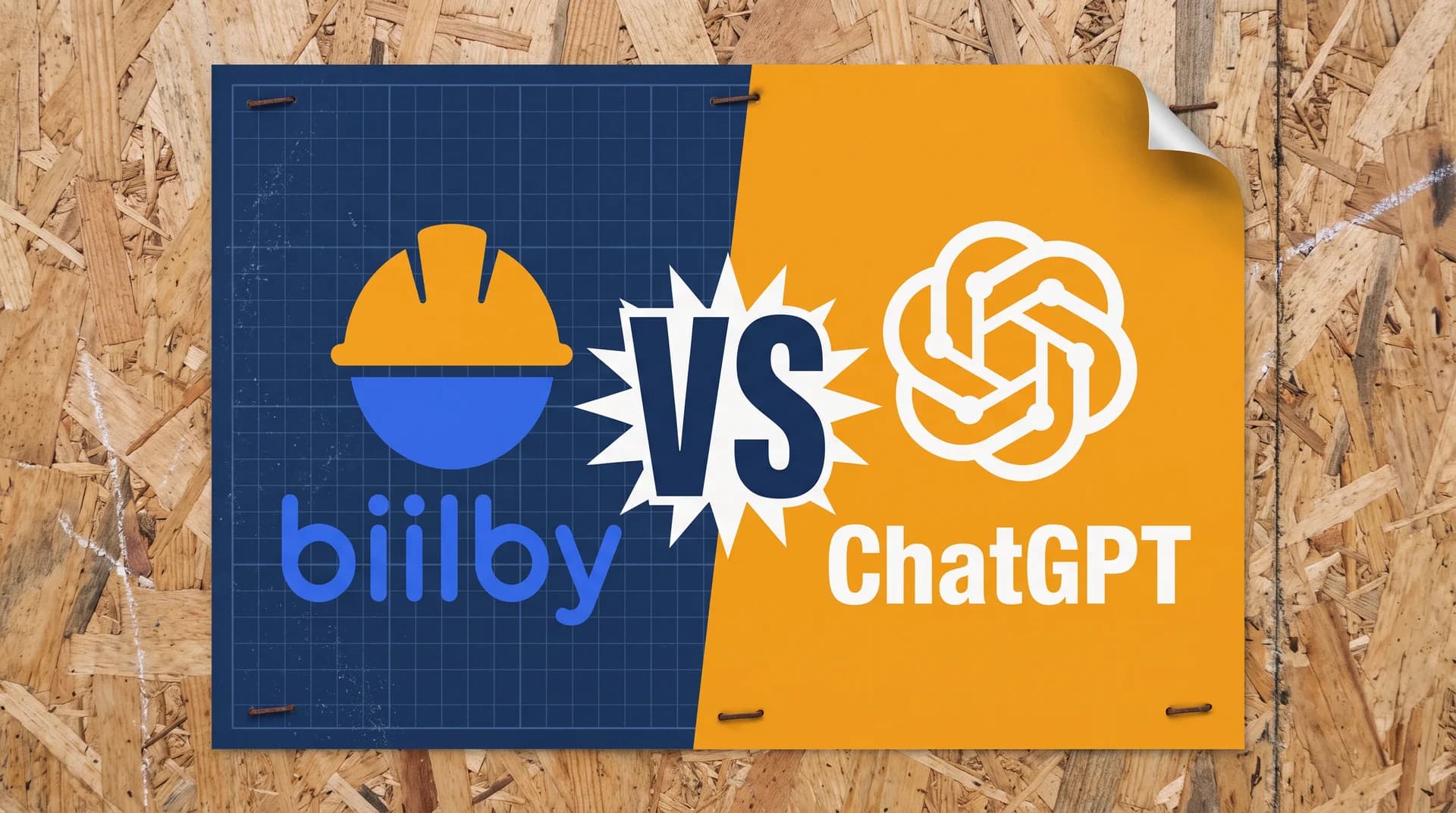
It's a fair question, and we get it in almost every demo. ChatGPT is already on everyone's phone. It's good. It costs a fraction of any construction software. So why add anything else?
Let's start with the part that usually surprises people: Biilby runs on Mistral. You can open Le Chat right now and talk to the same model we do. We didn't train a construction AI, and we're not going to tell you ours is smarter than the one you already use.
So the answer has nothing to do with the model. It's about everything around it.
The short answer
ChatGPT is your assistant. It belongs to you, it answers you, and when you close the tab the conversation goes with it.
Biilby is the site office. Not the one at head office — the one on the project, with the plans on the wall, the schedule up to date, and rules about who's allowed to change what.
Same model. Very different thing to ask a question of. Three things make that difference, and the third is the one that actually matters.
There's more than a conversation behind it
Take the crack in the kitchen of apartment 304.
The site manager sends a photo and one line of text, the way he already does on WhatsApp. What happens next isn't a reply. It becomes a field observation, associated to apartment 304, so it sits next to the plan it concerns in the Drawing Navigator. The finishing works are already on the Weekly Plan, so the observation attaches to something with a date. That date sits on the Master Schedule, where a slip on finishings is visible against everything downstream of it — including handover. The next morning it's in the project manager's Daily Briefing, because it's his problem now and he hasn't seen it yet.
Ask ChatGPT about the same crack and you'll get a sound answer about cracks. Ask it again in three weeks and it has never heard of apartment 304.
None of that is a conversation. It's a schedule, a register, a set of plans and a briefing that all knew about each other before anyone asked. That's the difference we wrote about in Biilby is not just a chat: the chat is the door, not the house.
You run the site. You don't run it alone.
Here's what a personal assistant can't fix.
On Tuesday, the project manager works out how to resequence around a late window delivery. He does it in his own chat, and it's good thinking. On Thursday the site manager hits the same problem on the same lot, and none of Tuesday exists for him. Two competent people solve the same problem twice, three days apart, and neither knows the other did.
That's not a discipline failure. It's what happens when the tool is personal and the job isn't. A construction project is twenty people touching the same thing, and coordination is most of the work. Your ChatGPT can't be the project's memory, because it was never anyone's but yours.
Who's asking changes the answer
This is the part that's genuinely hard to build, and the reason a construction AI can't be a clever prompt on top of a generalist one.
Biilby lives in your company, not in a personal account someone opens with a Gmail address and takes with them when they leave. Inside it, your workspace carries your settings and your way of running projects — because two contractors run the same trade differently. And inside that, rights are set per project, because the same person can lead one job and be a subcontractor's contact on another. Same human, two different sets of things he can touch.
That shapes what Biilby tells you.
What you can see
The subcontractor asking about his lot gets his lot. Not your margins, not the other trades' claims, not what the client said about the penalty clause. Everyone claims this one, and rightly — it's the baseline.
What you can change
This is the half nobody else can claim.
If you're not allowed to move a date, Biilby won't move it for you. Ask it to push the finishings by a week and it will tell you plainly that you don't have that right — and then tell you who does, so you're not stuck. It doesn't quietly find a way around the rules, and it doesn't leave you at a wall either.
Enterprise ChatGPT has workspaces, single sign-on and admin controls too. But those rights govern documents and chats — who can open what. Biilby's govern the project itself: who can move a date on an activity, who can close a non-conformity, who can approve a revision. You can't have rights over a schedule if there's no schedule underneath. It isn't a gap the generalists are choosing not to fill. It's a different business.
And it's what makes the rest of it safe. We built Biilby to live inside the chaos rather than fight it — to let the site keep communicating exactly as messily as it always has. The obvious objection is that nothing stays under control that way. The rights are the answer. The structure sits in the software, not on the people.
Biilby makes the chaos speak — and keeps it under control, without asking anyone to organize it.
A European model, on European servers
Biilby runs on Mistral, hosted in the European Union, on infrastructure owned by European companies. Your projects are never used to train a model for anyone else. For a director signing off on a tool that will hold every drawing, every claim and every margin on the job, that isn't a detail.
Different products, not competitors
None of this makes ChatGPT worse. It makes it a different thing.
You'd ask ChatGPT to draft the letter to the architect, or explain what a norm actually requires, or help you think through a clause before you sign it. It's very good at that, and Biilby isn't trying to be.
You'd ask Biilby whether the crack in 304 threatens the handover date, who needs to know, and what it does to the ranges on the schedule. Nobody would want both answered by the same thing.
Keep ChatGPT. It's a good assistant. Biilby is for the project everyone is working on together — and that's a job that needs to know who's asking.
Want to see it on a project like yours? Get a demo.