

Adding AI to your tool helps. Building your tool on AI changes the method.
Published August 31, 2026 · By Frédéric Debouche
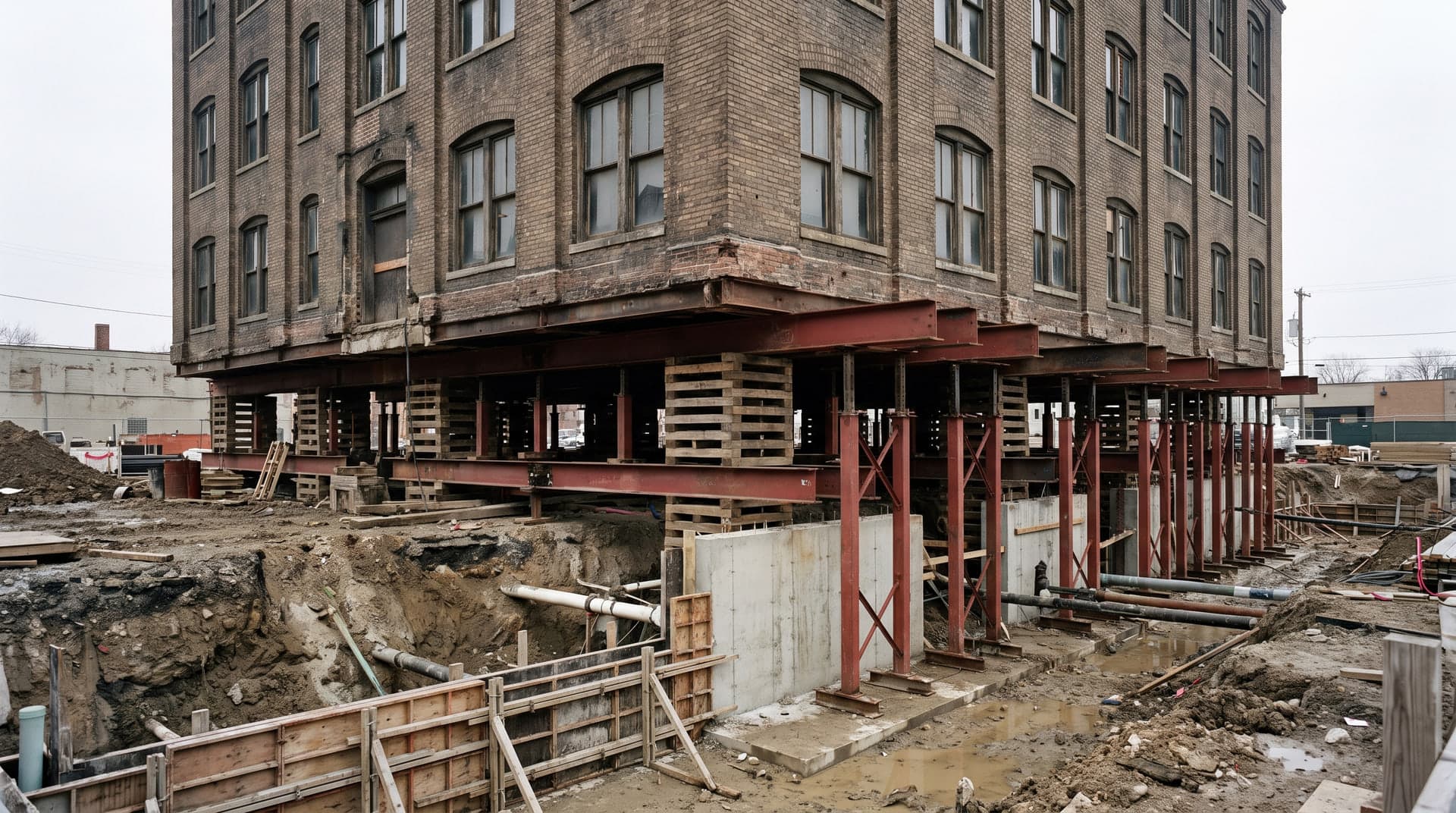
A site manager walks into apartment 304 and sees a crack in the slab. He knows what it means the moment he sees it — which trade, roughly how serious, who needs to hear about it, whether it touches the finishing works. Then he opens the software, and the second job starts: pick a category, pick a location from the dropdown, set a severity, name a responsible party, set a due date. None of that taught him anything. It was a translation, from what he already understood into something a machine could hold.
One site, ten thousand small facts
Now multiply that moment by a day on a real project.
A delivery arrives three pallets short. A subcontractor turns up with two men instead of five. A detail gets resolved verbally at ten in the morning between two foremen on a landing. A zone is unavailable because someone else is still working in it. A drawing revision lands and only half the trades notice. Every one of those facts matters to somebody, and every one of them would have to be encoded by a person before any system could use it.
That's not a speed problem. Even at zero seconds per entry, three things break:
- Volume. Nobody records every minor detail, because doing it means someone stops running the site and starts operating the software full time.
- Selection. So people encode a fraction — and the fraction gets chosen by what the form formally requires, not by what actually matters this week. The system ends up holding the reportable subset, not the state of the project.
- Decay. The fraction that does get in is already drifting. The site moved while the form was being filled. By the time the weekly report is assembled, part of it describes a project that no longer exists.
And nobody chose that. Software couldn't read a photograph, a voice note, or the way people actually talk on site. Structure had to come from a human, before the fact went in, or it didn't go in at all. Rigid schedules, fixed fields, coded document registers — those weren't lazy design decisions. They were the only way a machine could hold a project. That was the ground everyone worked on, and it's the ground we described when we explained why we built Biilby.
Adding AI to construction software genuinely helps
Take that same method and put a good model on top of it. Real things improve. Fields get suggested instead of typed. Reports get summarized. Search finally finds the document. Emails draft themselves. Anyone who has done a Friday afternoon of report writing knows exactly what that's worth.
But look at what didn't move. Someone still decides that the crack belongs in a category. The categories still have to exist before the crack does. The encoding still happens — a person, or now a model, still translates reality into the shape the system demands. The volume is still unpayable, the selection is still driven by the form, and the record still decays between updates.
The method runs faster. It's still the same method.
The constraint the method was built around has lifted
Here's the part that actually changed. A model can take a photo, a sentence, a voice note, a marked-up plan, and treat it as real input — not as an attachment hanging off a properly-filled record. Unstructured reality became something a system can hold directly.
That isn't a feature. It's the removal of the precondition everything else was designed around.
Take the document register. Coding documents is where the encoding burden was always most visible: a naming convention, a discipline code, a revision letter, a zone, all applied by hand before a drawing became findable. Get one field wrong and the drawing is effectively lost. Built on AI, the drawing is filed from what it contains and what it's for, and it's found the same way — someone asks for the electrical plan for apartment 304 and gets it. No one had to code it correctly first.
It's the same shape as an argument we've made before: when a constraint lifts, what used to be unavoidable becomes a deliberate choice.
Same objectives, a different method
None of this is an argument against governance. Visibility, coordination, accountability — those were always the right objectives. They were just pursued by forcing structure onto a process that doesn't produce it. Reach them another way and they stay intact.
Planning that doesn't force a single date
A schedule built on forced structure gives one date and asks everyone to believe it. Expressed as ranges instead, the same activity carries three scenarios that are all simultaneously true, and the plan stays honest about what nobody knows yet. That's range-based scheduling — and it only works if the layer underneath it can keep up. A better model of time fed by forms is still stale. It's just stale about better dates.
Accountability without a control hierarchy
Old systems enforced responsibility by locking people into roles and approval chains. Biilby does it at the point of action: it won't act beyond what you're allowed to do, and when you ask for something outside your scope, it tells you who to ask instead. Same accountability. No hierarchy to maintain.
The forms weren't the flaw in the method. They were the price of a machine that couldn't read reality.
What building on AI actually means
It doesn't mean a chat window over the old database. Behind the conversation sit real, persistent objects — the master schedule, the phase and weekly plans, the document register, field observations, the daily briefing — that hold the project's actual state and keep it current. The chat is the way in. It isn't the product. We've made that case in full elsewhere.
Biilby proposes, and you decide. The site manager still calls it on the crack in 304. He just doesn't spend his evening typing it into a shape somebody chose three years ago.
The question worth asking now
Every construction tool on the market will tell you it has AI. That's no longer a useful question. The better one is this: what did this product have to assume before AI existed, and does that assumption still run the thing?
If the answer is that reality still has to be structured by a person before the software can hold it, then AI has made a good method faster. That's worth something. It just isn't the same as changing it.
Curious what the other version looks like on a project like yours? Get a demo.